
In the world of industrial safety, logistics, and construction across the United Kingdom, there is a dangerous and outdated misconception that Personal Protective Equipment (PPE) is a one-size-fits-all solution. For years, workers with larger frames, broader shoulders, and bigger builds have been forced to squeeze into standard-sized safety gear. Not only is this uncomfortable, but it is also a direct violation of UK health and safety laws.
When PPE does not fit properly, it fundamentally fails to protect the wearer. A harness that is too tight can dangerously restrict blood flow; a high-visibility vest that will not fasten becomes a severe snag hazard around machinery; and safety glasses stretched across a wider face create massive gaps where debris can enter.
To combat these hazards, the Health and Safety Executive (HSE) heavily polices the legal requirement that all PPE provided to workers must properly fit the individual.
If you are a business owner, a dedicated safety manager, or a worker looking for big and tall PPE in the UK, you need to know exactly what the regulations require regarding oversized safety gear. This comprehensive guide will break down the exact laws, specific equipment requirements for larger workers, and how to maintain compliance without risking a massive financial penalty.
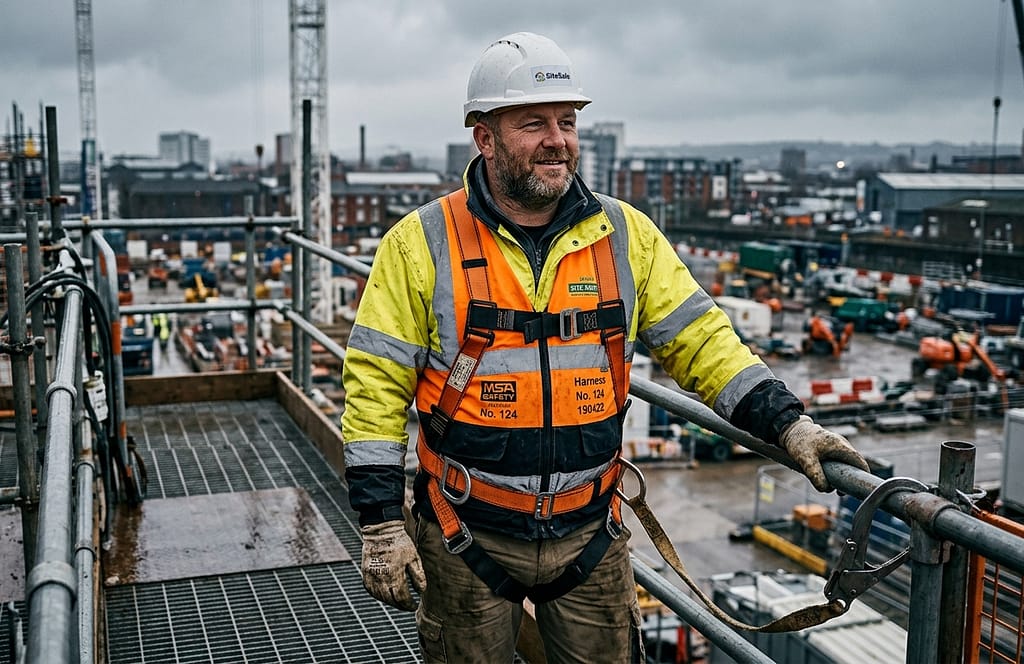
Table of Contents
The Core UK Regulations: Why “Proper Fit” is the Law
To score perfectly on your safety audits and protect your business from unlimited fines, you must understand the specific legislation the HSE uses to govern personal protective equipment.
The Personal Protective Equipment at Work Regulations 1992 (Amended 2022)
The cornerstone of British PPE law is the Personal Protective Equipment at Work Regulations 1992 (often called PPER 1992). Regulation 4 explicitly states that every employer must ensure that suitable PPE is provided to employees who may be exposed to a risk to their health or safety while at work.
Crucially, the statutory guidance supporting the regulation dictates that for PPE to be considered “suitable,” it must be capable of fitting the wearer correctly, with adjustments if necessary. Forcing a larger-framed worker to wear an undersized “standard” garment is considered the same as not providing any protection at all.
The 2022 Amendment: Extending to Casual Workers
A massive shift occurred with the implementation of the Personal Protective Equipment at Work (Amendment) Regulations 2022.
Prior to this amendment, employers were only legally required to provide and pay for PPE for directly contracted employees (known in law as “Limb A” workers). However, the updated law extended this duty to “Limb B” workers. This includes casual workers, freelancers, and independent contractors who do not have a traditional employment contract but carry out work personally for the business.
If a risk assessment shows that a Limb B worker requires a 4XL high-vis coat or an extra-large safety harness, the employer must provide it free of charge. You cannot legally deduct the cost of specialized oversized gear from a worker’s wages.
The True Cost of Non-Compliance in the UK
Under the Health and Safety at Work etc. Act 1974, breaching health and safety regulations can be incredibly costly. Unlike some countries with fixed penalty scales, the UK courts have the power to hand down unlimited fines. Fines are calculated based on the turnover of the business and the degree of hazard exposure. Small companies routinely face fines exceeding £20,000 to £50,000 for PPE failures, while larger corporations have been fined millions of pounds for systemic safety breaches.
Fall Protection Requirements for Big and Tall Workers
Of all the PPE categories policed by the HSE, fall protection is by far the most critical when it comes to body weight and sizing. Fall arrest systems are heavily engineered based on the laws of physics. When dealing with workers who weigh more than the industry standard, generic equipment can quite literally become a death sentence.
The 100 kg European Standard Barrier
If you look at standard, mass-produced fall protection harnesses and lanyards sold in the UK, you will notice that almost all of them are tested and approved under British and European standards (like BS EN 361) using a standard test mass of 100 kg (approximately 15.7 stone or 220 lbs).
It is vital to understand that this weight limit does not just apply to the worker’s naked body weight. It must legally include:
- The worker’s actual body weight.
- The heavy weight of their site clothing and thick steel-toe work boots.
- Their loaded tool belts, pouches, and any handheld equipment.
For many large or muscular tradesmen, their body weight alone exceeds 100 kg. Once you add their cold-weather site gear and a heavy pouch of hand tools, they quickly exceed the safe operating limits of standard 100 kg fall arrest systems.
What the Law Requires for Workers Over 100 kg
If a risk assessment identifies that a worker exceeds the standard 100 kg limit of your on-site fall protection equipment, the employer must take immediate action:
- Specialist High-Capacity Harnesses: You must source specialized full-body harnesses that are explicitly tested and certified for higher weight capacities—frequently up to 140 kg or 150 kg. These are designed with heavy-duty webbing and reinforced metal D-rings to withstand the higher kinetic forces generated during a fall.
- Energy-Absorbing Lanyards: You cannot legally attach a 130 kg worker to a standard shock-absorbing lanyard. Standard lanyards are engineered to deploy and tear at specific force thresholds based on a 100 kg mass. For a heavier worker, a standard lanyard may deploy too quickly or fail to adequately decelerate the fall. High-capacity lanyards are required.
- The Threat of Suspension Trauma: Beyond weight ratings, the physical dimensions of the harness are life-saving. Forcing a large-framed worker into a standard harness that is too small leads to a highly dangerous condition called Suspension Trauma. If the leg straps are too tight around the groin and upper thighs, a suspended worker can lose consciousness in a matter of minutes due to pooled blood flow. High-quality oversized harnesses provide the necessary room to prevent this emergency.
High-Visibility Apparel for Larger UK Frames
High-visibility clothing in the UK is governed strictly by the British Standard BS EN ISO 20471. Whether your crew is working in roadside construction, rail networks, or busy distribution warehouses, being visible is their primary defense against moving vehicle accidents.
For larger workers, finding compliant high-visibility apparel is often a struggle because bulk-buy warehouse orders rarely account for diverse body shapes.
Why Sizing Matters for BS EN ISO 20471 Compliance
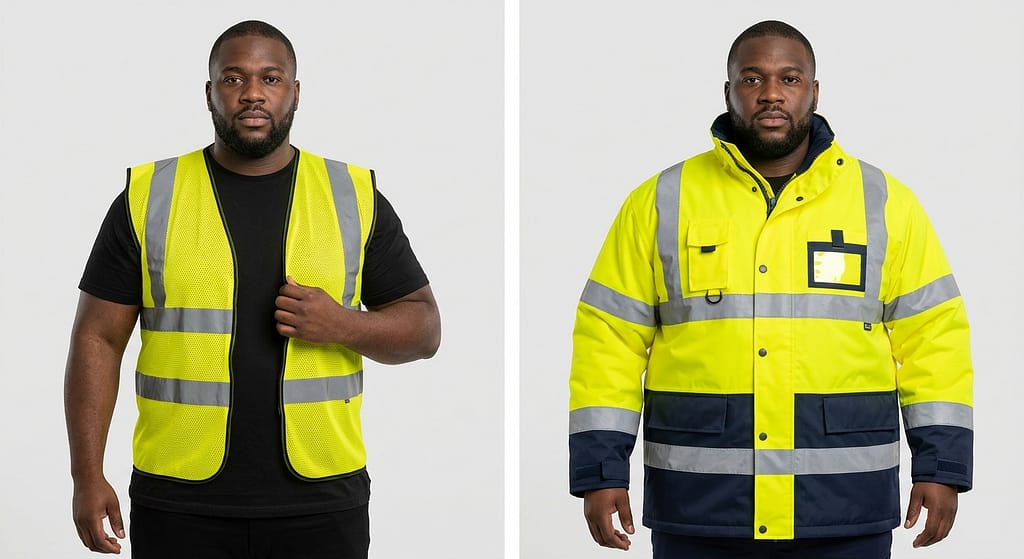
To meet the legal standards for Class 2 or Class 3 high-visibility, a safety vest or jacket must feature a specific minimum surface area of background fluorescent material and retroreflective striping.
When a large worker tries to wear a standard-sized safety vest that is too small, several dangerous scenarios occur:
- They Leave it Open: If a vest cannot fully fasten or zip closed over a broad stomach or chest, it flaps in the wind. This significantly reduces the continuous 360-degree visibility that the standard relies on.
- Snag Hazards: An unfastened, flapping vest easily snags on passing plant machinery, moving vehicles, or rebar, pulling the worker into a hazard zone.
- Restricted Mobility: If they force it closed, it restricts their reach and mobility, making it harder to perform heavy tasks safely.
Employer Obligations for Hi-Vis Gear
To comply with the HSE’s proper fit rules regarding high-visibility gear, you must ensure that:
- Vests, parkas, and trousers are stocked in genuine oversized cuts ranging from 3XL up to 6XL.
- The garments are designed with proper physical proportions (such as longer torso lengths for tall workers and wider cuts across the shoulder blades).
- The zippers or hook-and-loop closures can fully secure without overstraining the material or bursting open during physical labor.
Eye and Face Protection: Accommodating Wider Profiles
When discussing HSE requirements for oversized safety gear in the UK, eye and face protection are frequently ignored until a localized incident occurs. According to BS EN 166:2002 (the UK standard for personal eye protection), safety eyewear must provide a secure, gap-free seal around the eyes to protect against high-velocity impacts, chemical splashes, and fine dust.
The Danger of Ill-Fitting Frames
For workers with wider faces or larger heads, standard safety glasses often “pinch” uncomfortably at the temples. This isn’t merely an issue of workplace comfort; it constitutes a major safety failure:
- Lens Distortion: Frames that are stretched too wide cause the lenses to bow. This distorts the worker’s peripheral vision, making them less aware of moving hazards like site plant machinery.
- Gap Creation: The wrap-around protection becomes compromised. This leaves large gaps at the temples where flying metal shards, dust, or chemical droplets can easily enter.
- Non-Compliance: Workers will frequently push pinching glasses up onto their forehead to relieve the pressure. Under UK law, if a worker removes mandatory PPE because it is painful and hurts them, the employer is still at fault for failing to provide “suitable” gear.
HSE Requirements for XL Eyewear
To maintain strict compliance, safety officers must source Wide Fit or XL safety glasses. These are specifically engineered with wider nose bridges and longer, flexible temples.
- UKCA or CE Marking: Always verify that oversized eyewear carries the official UKCA (or CE) mark alongside the BS EN 166 code on the frame or lens.
- Full Face Shields: For tasks requiring full-face shields, ensure the adjustable crown mechanism can comfortably accommodate larger head circumferences. A shield sitting too high leaves the neck and throat exposed to injury.
Protective Footwear: Beyond the Standard Size 12
The HSE dictates that employers must provide safety footwear where there is a clear risk of foot injury from heavy falling objects or sharp penetrations. For big and tall workers, finding a site boot that comfortably fits is frequently the hardest challenge.
The Width Factor (Wide, Extra Wide, and EEE)
Under the standard BS EN ISO 20345, safety boots must pass stringent tests for impact and compression. However, the standard does not strictly dictate shoe width, which is where many larger workers suffer.
If a worker’s toes are cramped into a steel or composite toe cap that is too narrow, it leads to numbness, blisters, and loss of balance—a primary catalyst for workplace slips and trips.
- Providing Wider Widths: To fulfill the legal obligation of providing comfortable, suitable PPE, employers must cater to workers needing wide (EE) or extra-wide (EEE) fits.
- Higher Compression Resistance: For heavy-framed workers (particularly those over 130 kg / 20 stone), the static weight placed on the insole is significantly higher than average. To prevent premature wear or failure of the shock-absorbing properties, heavy-duty soles are highly recommended.
Standard vs. High-Capacity UK PPE Sizing Quick Reference
| PPE Category | Standard Equipment Limits | Oversized / High-Capacity Solutions | Applicable British Standards |
| Fall Protection | Rated for max 100 kg (approx. 15.7 stone) total weight including tools. | Rated for 140 kg to 150 kg (approx. 22 to 23.5 stone) with custom dimensions. | BS EN 361 (Harnesses) & BS EN 355 (Lanyards) |
| High-Visibility | Sizes up to XL. Often fails to fasten over broad frames, breaking 360° rules. | Proportional cuts from 3XL to 6XL with extended torso lengths and secure fasteners. | BS EN ISO 20471 (Class 2 & Class 3) |
| Safety Footwear | Standard widths up to Size 12. Rigid toe boxes can cramp wide feet. | Wide fit (EE) and Extra-Wide (EEE) options. Reinforced shock-absorbing soles. | BS EN ISO 20345 |
| Safety Eyewear | Standard frame widths. Prone to stretching, warping lenses, and leaving temple gaps. | XL / Wide Fit frames with extended temple lengths and broader nose bridges. | BS EN 166 |
How to Conduct a PPE Fit Audit for Oversized Workers
To prove your commitment to the Health and Safety Executive and reduce the risk of workplace liability, business owners and safety managers should run a regular PPE fit audit. Here is a step-by-step checklist to keep your team compliant:
- The Measurement Phase: Do not guess sizes based on everyday clothing. Use proper tailor tapes to measure the exact chest, waist, and head circumferences of your larger team members.
- The Dynamic Movement Test: Have the worker put on their 4XL or 5XL high-vis vest or specialist safety harness. Have them reach up toward the sky and then bend down to touch their toes. If the gear rides up aggressively into their armpits or prevents a natural bend, the fit is incorrect.
- The Total Mass Check: Weigh your larger workers while they are wearing their complete site gear and holding their standard tool belts. If their total weight exceeds 100 kg, cross-reference this against the rating of their fall arrest lanyards and lifelines.
- The “Two-Finger” Gap Inspection: Check safety glasses and respiratory masks. Can you comfortably slide a finger between the protective frame and the worker’s temple? If so, the goggles are too small and are flaring outwards, exposing their eyes.
- Maintain a Paper Trail: The HSE loves a paper trail. Keep a physical or digital record of your PPE fit assessments. Showing a “good faith” effort to provide tailored gear can massively mitigate financial penalties if an accident ever occurs on your site.
Conclusion: Safety Knows No Size
The takeaway is definitive: inclusion in workplace safety is not a luxury; it is the law of the land. Providing oversized safety gear—from 5XL high-visibility parkas to 150 kg high-capacity fall protection harnesses—is a fundamental legal requirement of a compliant UK operation.
As a business owner or site supervisor, your legal and moral goal is to ensure that every worker, regardless of their size or build, goes home at the end of the shift safely. By proactively investing in properly sized, HSE-compliant PPE, you are avoiding unlimited fines and protecting your absolute most valuable business asset—your workforce.
For the premium selection of Big and Tall PPE and oversized safety solutions meeting all UK regulations, explore our fully stocked catalog at https://www.google.com/search?q=dropuseful.com.